Buzz subject: Yggio

search buzz

[wpdreams_ajaxsearchpro id=16]
building systems

What Will Replace Building Management Systems?

Heating, ventilating, and air conditioning (HVAC) systems are dominated by a small group of large corporations (Carrier, Goodman, Rheem, Trane, York, Lennox, and Nordyne) who collectively control over 90 percent of the U.S. market. These companies use the same generic terms to describe their operating systems, building management system (BMS) or alternatively building automation system (BAS). While these systems can be good at energy optimization and comfort control, HVAC accounts for just 40 percent of a standard commercial building’s total energy use, leaving a big gap to fill.

But the important thing is that it changes the focus of the building system to the entire building in a way that does not revolve around just heating and cooling. This shift is made possible by two shifts in technology.

At Sensative, we call it Digitalization infrastructure Management System – DiMS, and our Yggio DiMS is not only limited to Buildings. It enables Smart Buildings, Cities, Homes, Agriculture, Ships, to list a few…

shutterstock 663740458 e1563285975438

What Is a Smart City Platform?

In a data-driven society, the sheer volume of data is accelerating on an upward slope.  Our reliance on human-machine collaboration to be successful will require the velocity, veracity, security and the universal interoperability of data.

The explosion in hardware vendors, the number of communication protocols, and the lack of standardization of metadata and labeling among system integrators have created an environment in which data brokering between devices may be lost in translation or broken.  The desired flow of data back and forth between databases, levels of the technology stack, applications, industries, regions, countries and freely throughout the global economy does not yet exist.  The vision of machines flowing seamlessly around us and enhancing our lives sounds wonderful, but this utopia will remain a fantasy if communication barriers remain and the data the sensors are collecting cannot be used to provide contextual awareness.

Vendors have always preferred proprietary and closed systems since these tend to garner premium prices and lock a customer into a specific vendor.  Cities should take advantage of the potential power they now have to collaborate to accelerate and institute radical changes to the market.

The EU has been working strategically with FIWARE and the Open and Agile Smart Cities (OASC) group to standardize on the same open-source platform.  This standardization effort has spread to Brazil, Mexico, and most recently to Japan with its new partner, NEC.  The EU is working on setting a single standard for data brokering between countries, as the ability to pool data into data oceans over data lakes will (in theory) generate deeper and more accurate analytical insights.

If you want an open IoT for Smart City, then FIWARE is a natural choice in Europe. But FIWARE comes with some limitations. Those limitations are what we solve with Yggio. We build upon FIWARE components, data models and API standards, but we add the missing pieces and much more.

AI in IoT.hero

We currently have no smart cities — by 2025 there’ll be 26

Spending on smart city technology is expected to reach US$327 billion by 2025, up from US$96 billion in 2019, according to a new forecast from Frost & Sullivan.

The analyst company said an uncertain post-pandemic situation will compel cities to focus on developing collaborative, data-driven infrastructure for use in healthcare, public security services and more.

Artificial intelligence and data-driven solutions are expected to be in high demand, with growing opportunities for crowd analytics, open data dashboards and digital city services.

The kind of multi-party multi-network platform that Sensative already supplies to multiple cities, municipalities, and real estate companies in Sweden. Will Sweden again take the lead when it comes to new infrastructure and communication, like when Telia, Ericsson, and Nokia (yes, they are Finns, our closest neighbor) invented mobile phones and cellular GSM networks?

sensative yggio turning buildings int Teslas

Unmanageable Smart Building Complexity is Holding Back Progress

Tesla vehicles have far more digital devices and software than a traditional vehicle. Teslas are almost like the smart buildings of the automotive world, except they have been widely accepted by users leading to a healthy 30-40% increase in sales year-over-year. To overcome the interoperability issues faced in their vehicles, Tesla integrated all devices and hardware around a single central software architecture, giving the firm an almost seamless ability to update software and optimize vehicle performance. There are limits to the Tesla – smart building comparison, of course, but also important lessons to learn.

Sensative Yggio – turning buildings into Teslas

smart city connectivity integrated by yggio

Unlocking the potential of the Internet of Things | McKinsey

If policy makers and businesses get it right, linking the physical and digital worlds could generate up to $11.1 trillion a year in economic value by 2025.

This report from McKinsey Global Institute predicts that 40% of the total IoT value comes from having systems and devices that can communicate with each other. Without this companies will miss out on a potential $40 trillion each year globally.

city woman thinking connectors mesh 2012 780x371

The potential for MQTT in realizing the smart city vision – Secure Insights

MQTT is likely to play a great role in the realization of smart city goals. Learn about the potential benefits of integrating MQTT into video surveillance

In the IoT business, MQTT is a standard protocol, and Sensative’s integration platform speaks to it natively. With the MQTT ACAP software in the camera, we can extract an event/alarm – meaning utilizing the camera purely as an IoT sensor – without us ever accessing the video stream, which could be highly sensitive.

For example, we now use Axis cameras for people counting in office environments for facility management and COVID-19 related monitoring – everything is integrated in real-time into the Building Management Systems.

Using MQTT simplifies the complexity of configuring IP-networks for two-way communication and lowers the load on servers by reducing data overhead.

42f3ff24bd79273c635f8d6f7158c110

The IoT: Yesterday’s Predictions Vs. Today’s Reality

Here’s a look at some of the key predictions we at Forbes Technology Council initially had for a fully connected world, the reality we are dealing with today and how businesses can best prepare for the IoT’s continued evolution.

The biggest obstacle is the complexity of technologies, standards, silos and legacy systems. IoT requires interoperability and co-operations in eco-systems to be able to deliver on the expectations.

proptech integration

The Future of PropTech Will Be Mass Integration | Propmodo

The past several years have demonstrated that real estate technology is on an upward climb, delivering undeniable value to the largest asset class in the world.

“…an interconnected system in the workplace will no longer be a thing of the past, the linking of manpower, technological devices and other items of business will become a necessity as opposed to just a perk. Office users now use 50 different tech products throughout their day, and none are connected, making being productive less than simple. “

The biggest challenge for property owners is the plethora of systems, vendors, and technologies already installed in the buildings. Adding new tech like IoT makes it even harder to integrate and build upon.

What you do need is an operating system for the building, a platform that handles all the technology in the building, providing a standardized way of developing services and applications, very much as a computers operating system manages all the internal components and attached peripherals. SW developers do not need to address what a manufacturer of the memory board, hard drive or printer has implemented, it is all managed by the OS.

The OS for buildings is called Yggio, provided by Sensative.

steinar engeland VKlIQTmJfVY unsplash

The Connected Ship | Nordic Innovation

This project will support a more sustainable, digitalized and connected maritime industry.

Ships are increasingly being automated and maritime equipment is often controlled by software and programmable devices. However, these control systems on-board are isolated vertical systems dedicated to specific tasks that are not able to communicate with each other or share data.

The goal of the Connected Ship project is to develop and implement a horizontal ship digitalization platform to connect the different digital automation systems and sensor networks across different communication standards on board a ship. This will allow for the shipowners to access and analyze more relevant data to improve vessel performance and reduce costs.

Sensative part: The IoT platform Yggio and all related activities.

Interested in Sensative R&D projects? Read more here

7 Most Demanded Iot System Integration and Professional Services featured image min

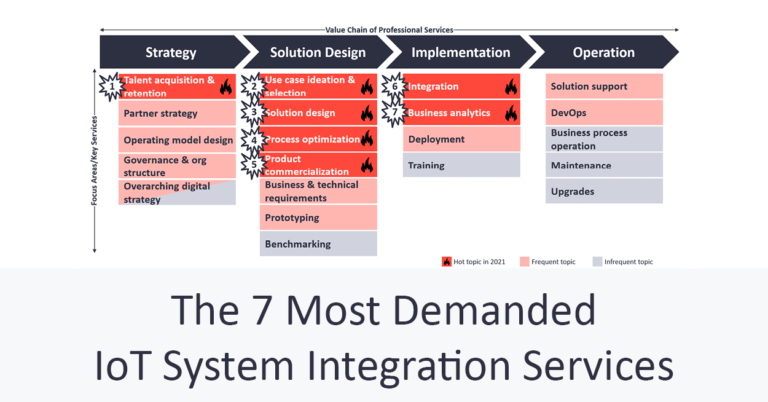
The 7 Most Demanded IoT System Integration Services

In short Seven focus areas are currently in high demand for IoT system integration and professional services.

The focus areas of today are further downstream in the value chain (mostly in the solution design and implementation stages) than in years past.

Due to strong demand, many technology vendors are building out their own integration capabilities.

Why it matters? Companies offering IoT system integration services need to address these high-demand areas.

Companies implementing IoT projects may need outside help in some areas to ensure success. The shifting IoT system integration value chain Of the companies that hire system integrators, 78% do so because they

This is highly interesting since Sensative offers THE MOST CAPABLE open IoT integration platform on the market, Yggio 🙂

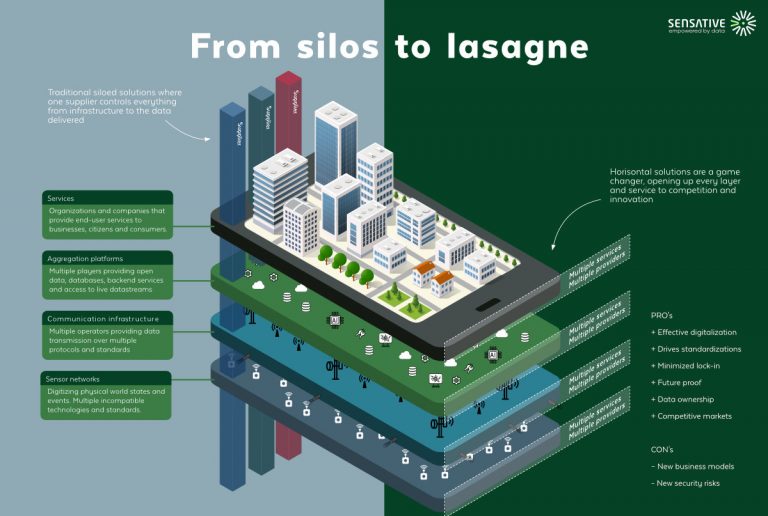
from silo to lasagne - the Iot model that revolutionizes smart city and smart buildings

The 5 Layers of the Smart City

Today many cities find themselves unable to truly harness the potential of the smart city technologies available. In order to maintain the orientation and focus on a practical way to make cities smarter it can help to focus on five distinct layers of the smart city that need to be understood and managed.

Sensative take:

Cities often start with a vertical use case, for instance, building systems for smart lighting. This could be considered “easier” since it is controlled by one internal department and you could let one supplier deliver all HW and SW for an immediate effect. However, this is not necessarily the best approach to build a foundation for a Smart City. It just solves one of the thousands of imaginable use cases in a city.

The city should start with a Smart Architecture like the one discussed in this article. Then it becomes much clearer what requirements to put on the different suppliers. This architecture must be open, based on standards, and horizontal to cover all use cases, departments, suppliers, and technologies. This enables data sharing between use cases and departments and opens up for the reusing of taken investments in many new use cases.

When selecting the IoT platform that perfectly fits in this architecture it is not that easy. How to select a platform that doesn’t lock you in? Where you retain complete control over all data, where you easily can add new technologies, new data-flows, new vendors, mix cloud providers, and add new internal or 3rd party services that are cross-organizational. Where you also can integrate your city with your neighbors to share services, data, and cost.

It is based upon these requirements we’ve developed the Yggio IoT integration platform.

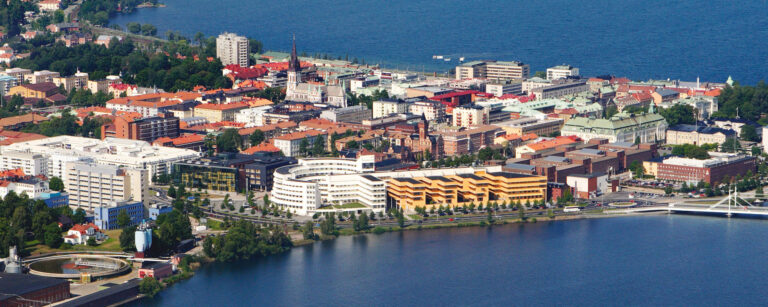
Jonkoping a sensative customer.hero

Standarder förenklar kommuners satsningar på IoT – IoT Sverige

IoT Sverige driver på för användningen av internationella standarder och en gemensam IoT-vokabulär.

Source: Standarder förenklar kommuners satsningar på IoT – IoT Sverige

Standarder är oerhört viktigt för utveckling av den smarta staden, och alla andra “smarta industrier” för den delen med. Standarderna gör att du blir mindre beroende av leverantörer och olika teknikval, att du dessutom kan dela tjänster och utveckling med andra städer. Inte bara dela goda idéer utan faktiskt spara stora pengar på att dela tjänster med varandra.

Search

Unlock!

Downloading a PDF is an exclusive service to our community. Join now for free!
You will also receive our monthly newsletter with the latest about Sensative, our users, and IoT.

By checking this box, I acknowledge that my email address will be stored by Sensative per our Privacy Policy. We will also add a cookie for your convenience so you can download more documents without entering your email address again. However, your downloads will still be tracked by Sensative. You can, at any time, unsubscribe from these updates.

Thank you for subscribing to the Sensative newsletter

Your PDF download is now unlocked

Also, we have unlocked all services exclusive for the Sensative community