Data marketplace: your own data space
Share datasets between the accounts in the city’s Yggio, or between the cities of a region. The owner decides what is shared, and with whom.
The data exists, but nobody can find it
A city collects more data every year: traffic counts, air quality, energy, occupancy and surveys. Most of it sits with the department that collected it. The planning office does not know the environment department already measures the street it is redesigning, and the neighbouring town buys the same counts again.
European data spaces address this at continental scale. Most cities and regions need to start closer to home: a place of their own where datasets are described, found and shared, under rules they set themselves.
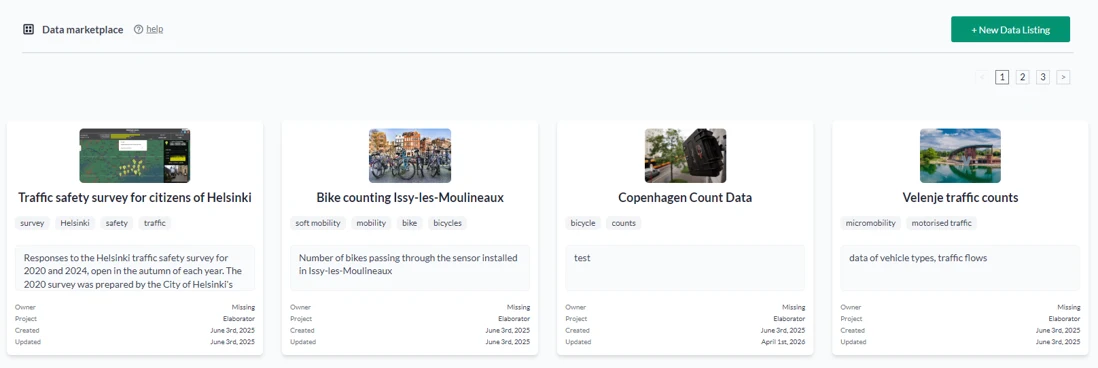
A catalogue of datasets, built into Yggio
The Data Marketplace lists datasets with what a reader needs to use them: a description, tags, links, images, the city it covers and who owns it. Users browse and filter by project, name, city and tags, and open a listing to see everything about it.
- Basic listings for lightweight entries: metadata, tags, links and images.
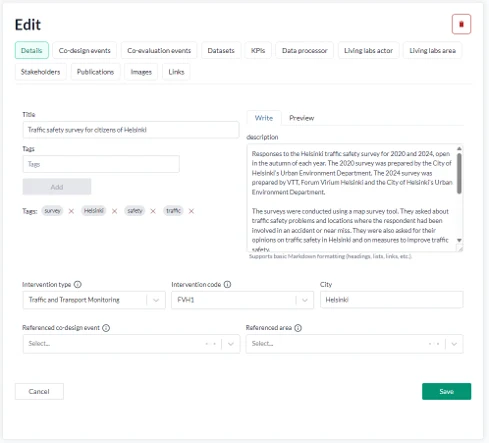
- Extended listings for evaluation work, built from structured sections: area, intervention, stakeholders, living-lab actors, assessment tools, data processors, datasets, KPIs and publications.
- Access per account. The marketplace is shown only to users whose account has it enabled.
Within the city, and across the region
Inside one city, the departments, companies and partners each have their own account in the city’s Yggio. A dataset listed by one can be found by the others and shared with them, such as the traffic office’s counts with the planners or the property company’s energy data with the climate team.
Across a region, the same works between cities: each keeps its own data and its own platform, and shares what it chooses with the others. Sharing runs on Yggio’s access rights and organisation hierarchy, so the owner decides who sees what (a whole organisation, a live group of devices or a single resource) and can withdraw it again at any time.
Developed in European city projects
The marketplace was developed with cities in EU projects where Sensative leads the shared data platform. In ELABORATOR, Living Labs across Europe share mobility data from their interventions, so results can be compared between cities. In GreenInCities, cities and Living Labs share data on urban greening and climate adaptation.
The extended listings come from that work: a listing can carry the intervention, the area, the stakeholders, the datasets, the KPIs and the publications, which is everything another city needs to understand and reuse the result.
Everything in the marketplace is in the API
Listings can be read, created, updated and deleted through Yggio’s open API, with the same project-based structure the marketplace uses. That is how a city portal, an open-data site or another data space picks the catalogue up without anyone retyping it. The request and response formats are documented in Yggio’s interactive API reference.
Start with the datasets you already have
Data Marketplace in Sensative Docs
- Pick the datasets other departments keep asking for, such as traffic counts, air quality and energy data, and list them first.
- Decide the sharing rules before the catalogue grows: who may see a listing, and who may use the data behind it.
- Enable the marketplace for the accounts that should use it.
- Invite the neighbouring cities once the city’s own catalogue works. The same rules apply, and each city keeps its own data.