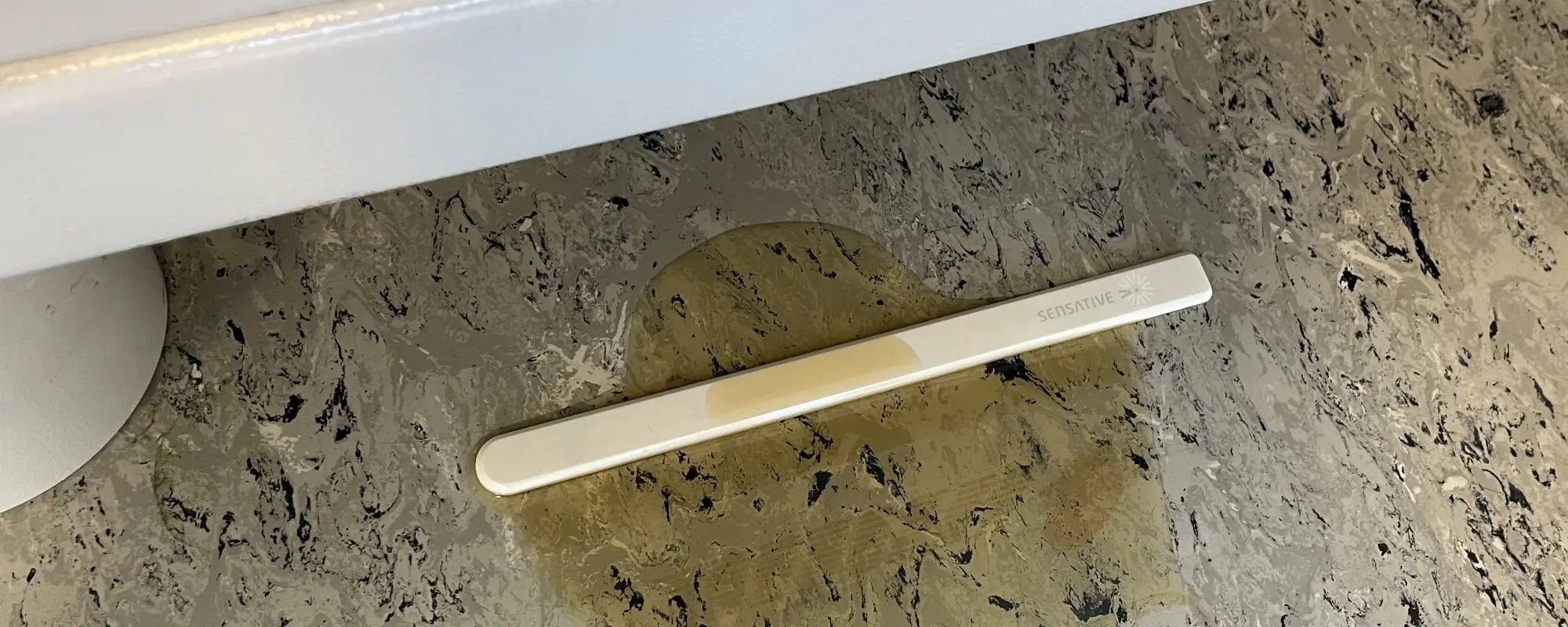
Leak detection that acts before a leak becomes damage
You cannot prevent every leak, but you can decide how long it runs before somebody knows.
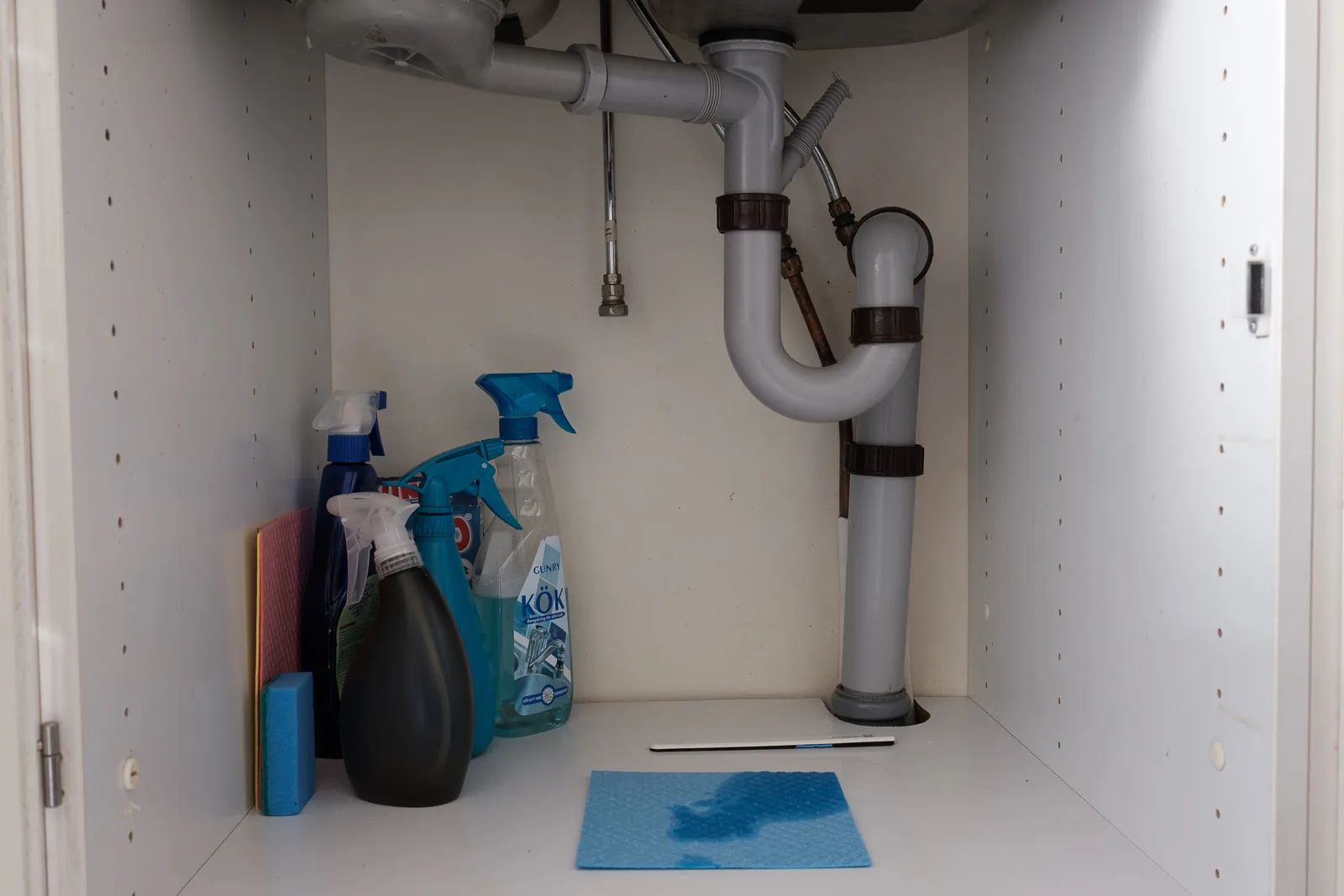
Leaks cost out of all proportion to their size
The leaks that ruin buildings are usually the slow ones. A burst pipe announces itself: somebody hears it, and the response is fast. A dripping coupling in a riser cupboard, a leaking hydraulic hose at an unmanned site, condensate overflowing a tray: nothing announces those.
A slow leak does its damage over days or weeks. The volume is small, but it goes on for a long time. It happens under, behind or beneath something, so it is found by a stain, a smell or a bill, and by then the cost is already committed.
You pay twice: for the repair, and again for the disruption. Tenants moved, production stopped, staff hours spent managing an incident, the deductible on the claim, and the claims history behind your next renewal.
Leak detection shortens the time a leak goes unnoticed
Pipes, seals and couplings will fail. What you can decide is how long a leak runs before somebody knows about it, and every hour removed from that number is removed from the damage.
That is where almost all of the money is. We will not quote industry averages at you, or promise a payback period we cannot know. Your own claims and incident history is the only relevant number; bring it and we will do the arithmetic together.
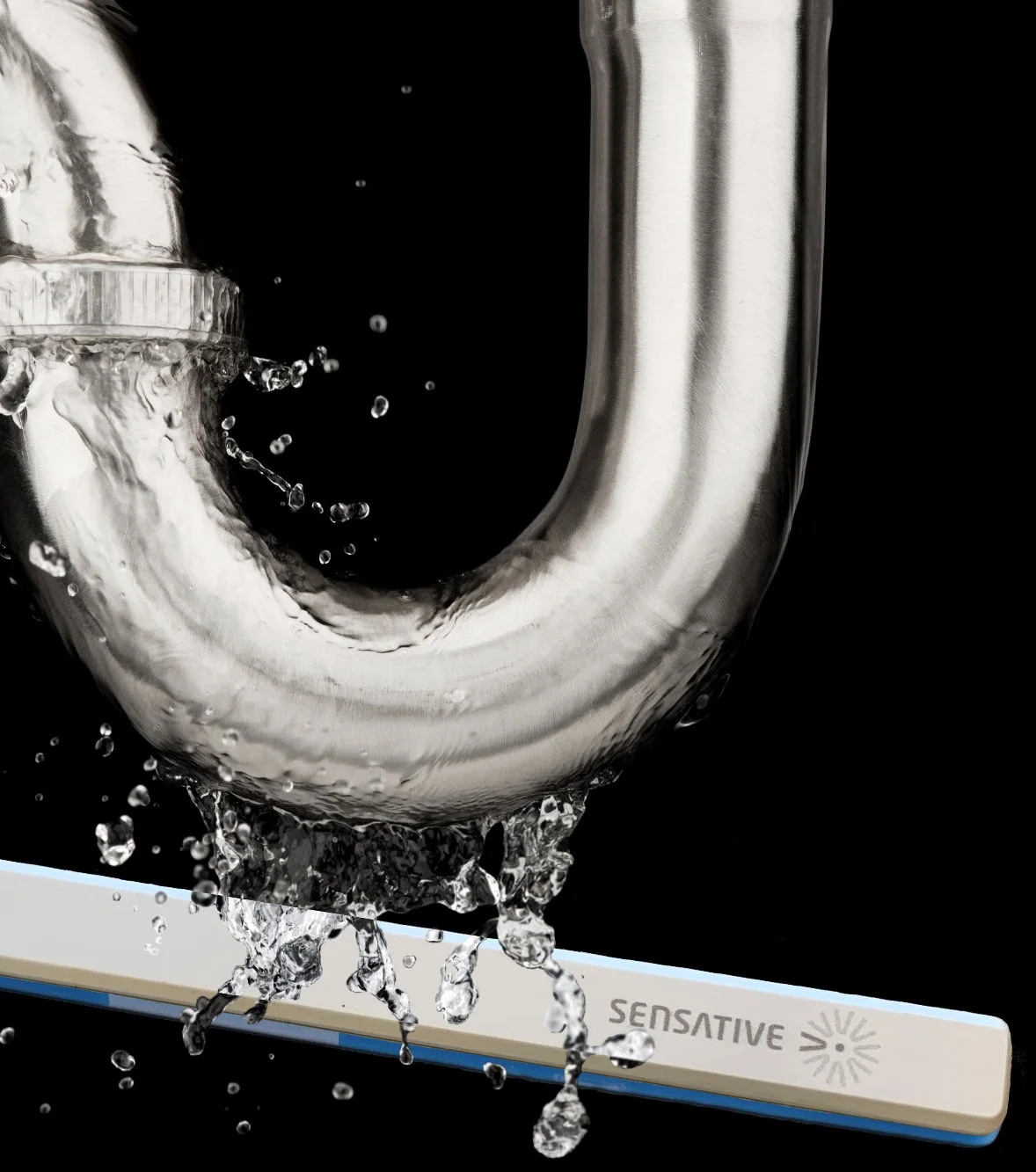
Every method has an exposure window
Inspection rounds catch a leak visible at the moment someone walks past, so the exposure is the whole interval between rounds. A tenant report needs a noticeable symptom, which means damage already exists. Moisture measurement in the structure finds damage, not the leak: too late by definition. Flow metering catches large continuous loss on a metered line, and misses small leaks and non-water liquids entirely.
A wireless pad sensor at the point of collection is the only method whose exposure is measured in minutes. It sits at the low point where the liquid will arrive and reports on its own, with no cable, no power and no round to wait for.
It does not replace the rounds. Rounds still find what a sensor cannot see: corrosion, a weeping joint above the sensor. This shortens the blind window; it does not remove the need to look.
Strips Drip: water
- Leak alarm with configurable sensitivity
- Temperature sensor (±2 °C), so the same unit also reports frost risk
- Patented
- Also available on Z-Wave 800-series for smart-home and B2B2C use
Strips Drip Oil: oil and more
- Two sensing layers: the outer alarms on any liquid, the inner sits behind a water-repellent, oil-absorbing membrane
- Water and oil are reported as different alarms
- Temperature sensor included
- Patent pending. LoRaWAN only
Two layers, not one filter
Detection is capacitive. Strips Drip alarms the moment its absorbent pads get wet; sensitivity is set per sensor.
Strips Drip Oil senses in two layers. The outer layer alarms on any liquid at all: water, oil, coolant or condensate. The inner layer sits behind a water-repellent, oil-absorbing membrane, so water never reaches it while oil and other liquids do. One layer wet means water; both layers wet means oil or another non-water liquid, and the alarm says which.
It does
- Detect liquid arriving at the point where the sensor sits
- Report within the configured interval, day or night
- Separate a liquid leak from an oil leak (Drip Oil, two layers)
- Warn before an unheated space freezes (Drip)
- Rearm itself after a water leak, on either sensor
It does not
- Find a leak that never reaches the sensor, or stays below it
- Measure a flow rate, a volume or a total loss
- Name the liquid, or measure its concentration
- Replace a temperature or comfort sensor, as it is ±2 °C
- Rearm itself after an oil leak, because the oil-absorbing membrane is a consumable
Coverage is a design decision, not a product feature
In buildings, most claims come from the same places: under sinks and kitchenettes, behind dishwashers and washing machines, water heaters and boiler rooms, sprinkler valve rooms, riser cupboards and vertical shafts, district-heating substations, condensate trays under cooling and air handling, lift pits, basements below grade, server rooms, and archives where the contents cost more than the floor. Unheated spaces get a Drip regardless, because the same sensor warns before it freezes and alarms if it already burst.
At plant and remote sites a leak is often a compliance event before it is a repair job: hydraulic power packs and hoses, machining coolant systems, compressor rooms, transformer bunds, oil storage and its secondary containment, refuelling points, wind turbine nacelles, remote pumping and telecom sites. A site nobody visits weekly has an exposure window measured in weeks, and that is where the ratio between sensor cost and avoided cost is at its most extreme.
A tip for dishwashers, washing machines, fridges and freezers: put a leak tray under the machine (an inexpensive plastic floor protector from any home store) and place a Strips Drip in the tray where the water collects. The tray stops a slow leak from reaching the floor, and the sensor tells you about it the same day instead of when the floor starts to swell.
The list gets made from your own claims history, then a walk-through placing each sensor at the lowest point where liquid would collect. Ten well-placed sensors beat a hundred placed from a floor plan alone.
From detection to acknowledged action
A detection that nobody acts on is not worth installing. Yggio turns the alarm into a chain with an owner: route it to the right recipient, escalate it if nobody acknowledges, and keep the audit trail of who was told and when.
Sensitivity is a trade-off, and it is yours to set: higher sensitivity means earlier warning and more nuisance alarms. It is configured per sensor and per location, because a plant room and a server room should not be set the same.
The sensors work on any compliant LoRaWAN network, and Yggio works with any vendor’s devices. Take one, or both.