Yggio, the open operational layer for the physical world
Every sensor, network and protocol behind one open API, so cities, buildings and utilities can run on their own data, with their own suppliers and on their own terms.

A platform that hands you the keys instead of locking you in
Most platforms create vendor and data lock-in. Yggio does the opposite: it connects any sensor, IoT or IT system and hands the data back to the customer through one open API, whatever the manufacturer or protocol.
What Yggio actually does
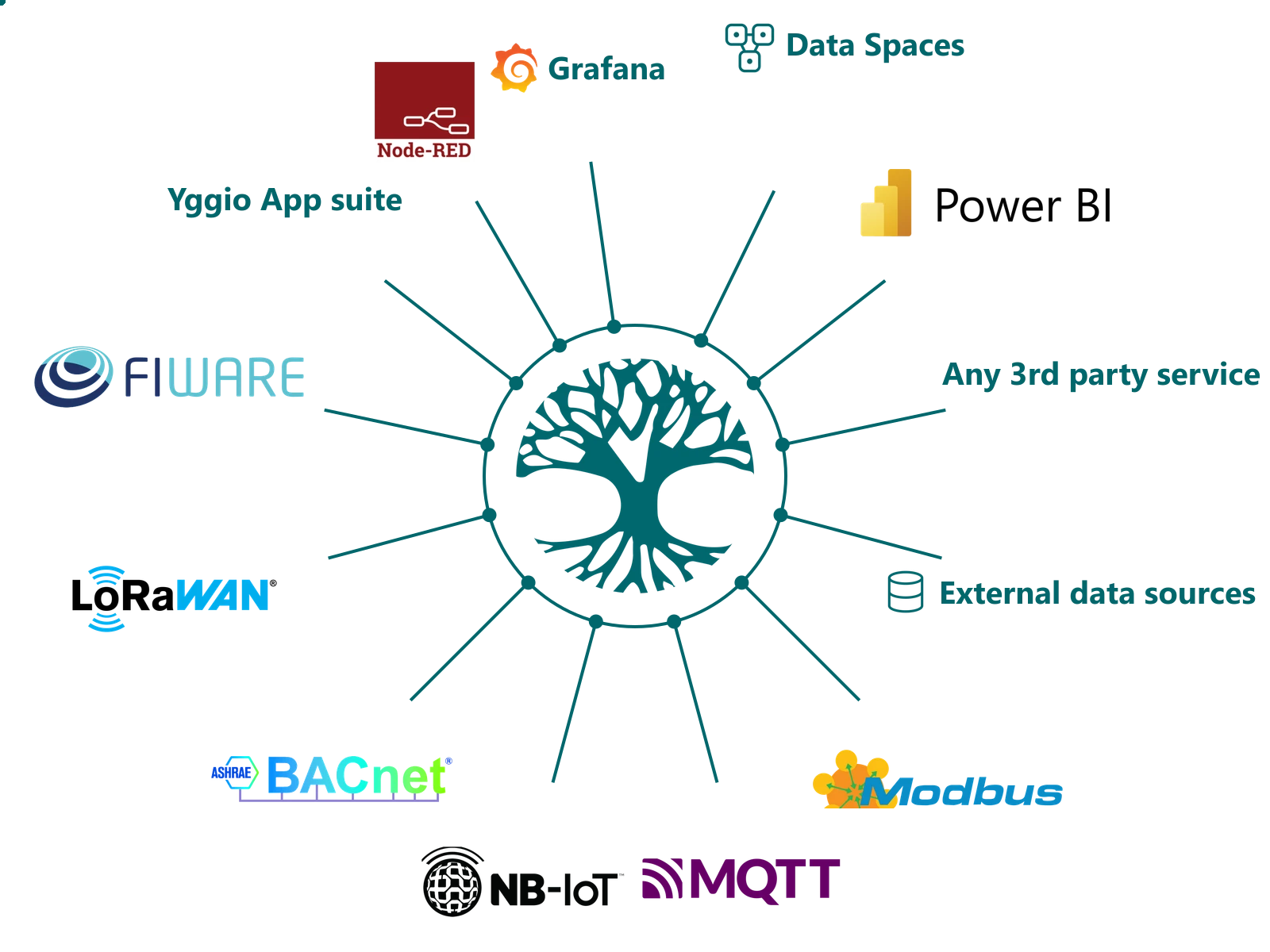
- Yggio connects sensors, meters, gateways, building systems and external data sources over LoRaWAN, NB-IoT, MQTT, Modbus, BACnet and more, with 500 ready-made device translators, so you never write a driver.
- All data follows one model, based on NGSI-LD and enforced across every translator. Every field carries a type, a unit and a quantity, and the same name whichever vendor made the sensor.
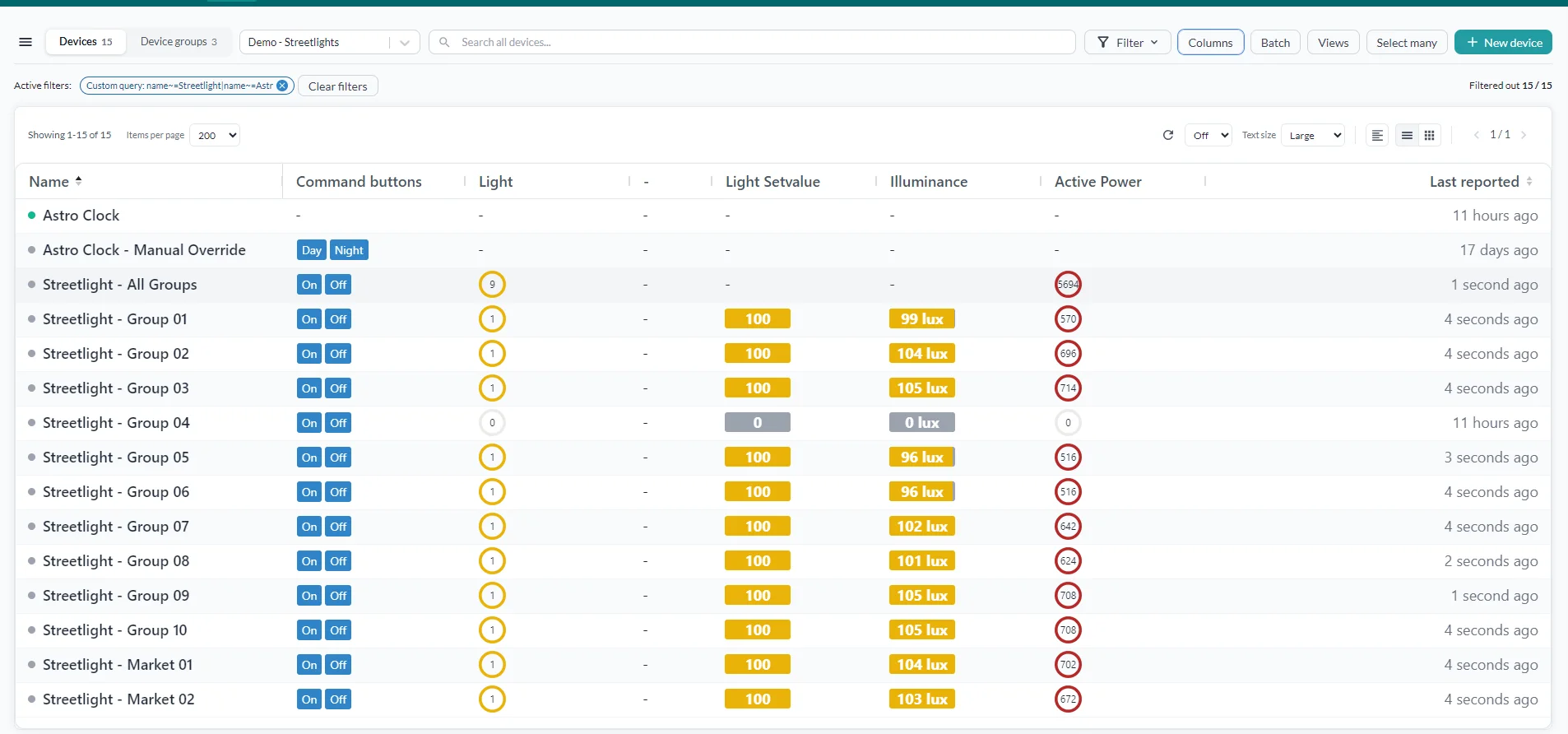
- Inventory, status, battery and network quality sit in one device list with saved views. You onboard, replace, upgrade and retire devices from one place, whether you have ten or a hundred thousand.
- An organisation tree with roles and Admin / Read / Write / Peek rights per resource decides who sees what, for people, services and AI agents alike. You can share one device, a live device group or everything a member owns with several organisations at once.
- A drag-and-drop rule engine turns readings into action: triggers, conditions and actions on a canvas, with debounce per device, delays and retries, an execution history per rule, and rules that are shared like any other resource.
- Dashboards show charts, gauges, tables, floor plans and geomaps, with radio-coverage analysis on the map. Standard or custom reports run on demand or on a schedule.
- Grafana, Power BI, Node-RED, data spaces and your own applications all use the same API, and a marketplace offers services, sensors and datasets.
- Yggio runs as a service (by default with our partner Cleura for the EU market), on your own servers or at the edge. On your own hardware it needs a 4-core CPU, 16 GB RAM (6 GB at the edge) and 256 GB of disk, x86 or ARM, on Linux, Hyper-V or any major cloud. Upgrades are automated with backups taken first, and roll out to the public cloud, then private clouds, then on-premises installations, after four weeks of quality assurance. It has a zero-trust architecture, was independently penetration-tested in 2026 and includes an AI/ML framework, plus an AI assistant in the control panel that answers from the documentation on your own OpenAI or Anthropic account.

Secure and sovereign by design, rule by rule
GDPR, NIS2, the Cyber Resilience Act, the Data Act, the AI Act, the proposed Cloud and AI Development Act and the US requirements: what each one asks, what Yggio and our sensors do, and what stays with you.
Your data, your operations, your sovereignty
- European by default. Developed and operated by our own staff in Sweden, and hosted in the EU for EU customers or on your own servers.
- Open, so you can always leave. One open API, one NGSI-LD data model and full export of your data.
- Independently tested. No critical, high or medium findings in the 2026 penetration test.
Connect anything and reuse everything
Yggio is vendor-neutral by design. It connects devices across LoRaWAN, LTE-M, NB-IoT, BLE, Zigbee, HTTP and legacy OT/SCADA systems, and supports open standards such as FIWARE and RealEstateCore, so your integrations stay stable as your hardware changes.
Built to fit into what you already run
Yggio’s open API and adapter framework let it slot into the IT and operational environments you already run, rather than replace them. Existing systems keep working; they just get access to more data.
Typical integrations include:
Built for use cases across industries
Start with one application and grow to thousands
Yggio runs in utilities, municipalities, buildings and transit networks, from a first pilot with a handful of sensors to fleets of tens of thousands, on the same platform.
In daily operation, beyond pilots
- The City of Stockholm runs Yggio as its central IoT platform: one data layer for a city of a million people
- IoT Västra Götaland: around 140 municipalities and public organisations share one Yggio instance instead of procuring one each
- LNER: more than 36,000 SeatSense sensors across the Azuma fleet show live seat availability on every service. Yggio also tracks wheelchairs at a major international airport
- Yggio 3 in production since 2021 · independently penetration-tested 2026 · Frost & Sullivan Technology Innovation Leadership Award 2021
New in Yggio 3.40
Rolling out to Yggio.se and customer installations from late September 2026. The highlights:
- New rule engine. Drag-and-drop flows: triggers (a report, a missed report, a schedule, sunrise and sunset, a button), conditions, delays and retries, and actions (email, SMS, MQTT, HTTP, LoRaWAN downlink, log or another rule). Debounce per device, ready-made templates and a run history for every rule.
- AI assistant. A chat in the control panel that answers questions about Yggio from the documentation, using your own OpenAI or Anthropic account, with a daily usage limit.
- One data model. NGSI-LD-based, defined and enforced across all translators. Existing devices are unaffected until you choose to upgrade, and you see the before and after.
- 250 new translators. Complete catalogues for Milesight, Dragino, Decentlab, Tektelic, Radio Bridge, Netvox and Browan; new alarm and calculation translators; Kamstrup, Axis, Barani, Diehl, Terabee and Xovis devices.
- Dashboards and map. Seven new widgets, radio-coverage analysis, geo-select of devices on the map, seven map layers and a redesigned device list with a connectivity preset.
- Sharing and sensors. Share a device, a live device group or everything a member owns across organisations. Over-the-air almanac and VSM app upgrades for Sensative sensors.
Product showcase
What Yggio is, why it is built this way, and a walk through the platform: organisations, permissions, rules, dashboards and reports.