Wireless sensors and Yggio, the open operational layer for cities, property owners and transport operators. Your data, your operations, your sovereignty.

Unity4Water - Värdeskapande av återvunnet vatten - Vinnova #2023-04047

Ongoing
Project lead: Mälardalen University
← Back to Research Projects
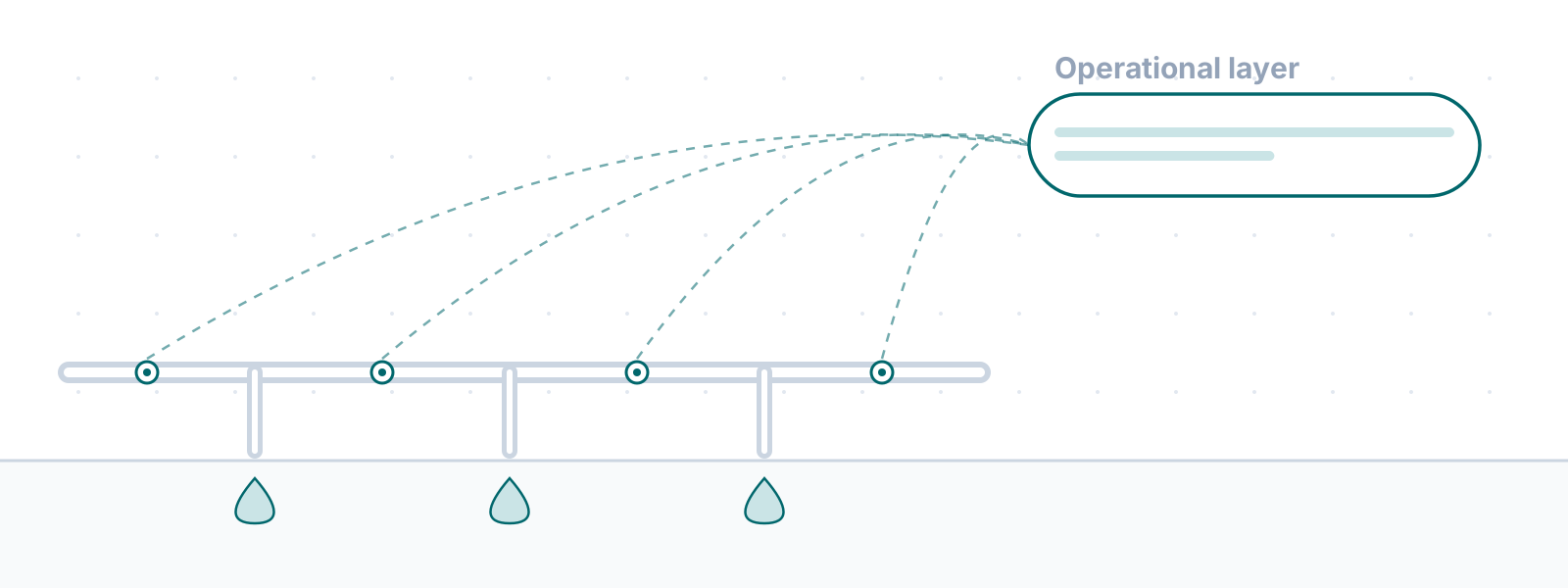
Schematic illustration: sensors on a water network feeding an operational data layer

Background

Water scarcity, climate change, and increasing demand from industry and food production are creating a growing need to use water resources more efficiently. At the same time, large volumes of process water contain resources that could potentially be recovered and reused instead of being discharged.

Unity4Water develops solutions for the safe and efficient reuse of process water in applications ranging from smaller cultivation systems to large industrial processes. The project combines water treatment, resource recovery, automation, digitalisation, and new business models to enable a more circular approach to water management.

By bringing together universities, research institutes, technology companies, and actors from agriculture and industry, the project aims to demonstrate how recycled water can become a valuable resource rather than a waste stream.
From wastewater to a valuable resource

Unity4Water investigates how water can be treated and reused while recovering other valuable resources from the process. Different technologies and applications are evaluated across both food production and industrial environments.

A key challenge is understanding when recycled water has the right quality for a specific application. Continuous monitoring and better access to process data can help operators understand changing conditions, optimise treatment, and determine how water can safely be reused.

The project combines these technical developments with sustainability assessment and business-model innovation, helping identify solutions that are environmentally beneficial as well as economically viable.

Digitalisation and smart water management

Digitalisation is an important part of making water reuse scalable. Sensors and connected systems can provide continuous information about water treatment processes, environmental conditions, and resource flows, replacing isolated measurements with data that can be analysed over time.

By collecting information from different systems into a common digital infrastructure, project partners can monitor processes, visualise results, compare experiments, and share relevant data. This creates a foundation for increased automation and more data-driven decisions throughout the water reuse process.

The combination of physical water-treatment technologies and digital monitoring enables more efficient operation while generating knowledge that can be transferred between different applications and industries.

Sensative’s role

Sensative contributes IoT sensing and Yggio to Unity4Water. Yggio is used to collect, store, visualise, and share data from project experiments and connected systems, providing a common digital layer between sensors, applications, and project partners.

Sensative is also exploring new sensing capabilities based on Square Air and Square CO2 platforms. The sensors are being developed to investigate whether volatile substances in water vapour can provide information about water content and quality without requiring direct contact with the water.

Together, the sensor development and Yggio data infrastructure support the project’s ambition to make water reuse more measurable, connected, and automated.

Towards a circular water economy

Unity4Water aims to demonstrate that recycled process water can create value across multiple sectors. Solutions developed for controlled cultivation, food production, and industrial processes can provide knowledge for wider adoption of water reuse technologies.

Connecting water treatment with sensors, digital platforms, automation, and resource recovery creates opportunities to reduce freshwater consumption and make better use of resources already circulating through industrial and agricultural systems.

The project thereby contributes to a transition from linear water consumption towards more resilient and circular water systems.

Water ManagementWater ReuseIoTCircular EconomyDigitalisation
Other participants (27)
  • RISE
  • Lund University
  • Mid Sweden University
  • Texas State University
  • Agtira
  • Billerud Gävle
  • Biotech Heights
  • Codon Consulting
  • Dahlbergs Slakteri
  • Direct Carbon
  • Eskilstuna Energi & Miljö
  • Global Food Parks
  • Granerfeldts Trädgård
  • Heliospectra
  • Mälarenergi
  • Nornio
  • PBS Generation
  • PiiA
  • Sensative
  • Siemens
  • Storbutiken i Lindhagen (ICA Maxi)
  • Smartare Elektroniksystem
  • SweGreen
  • Tebrito
  • Tetra Pak
  • Tornby Stormarknad Linköping (ICA Maxi)
  • Toppfrys
Funded by

Research enquiries

cto@sensative.com