Wireless sensors and Yggio, the open operational layer for cities, property owners and transport operators. Your data, your operations, your sovereignty.

SHIELD - EU4Health #101313738

Ongoing
Project lead: University of Bari Aldo Moro
← Back to Research Projects
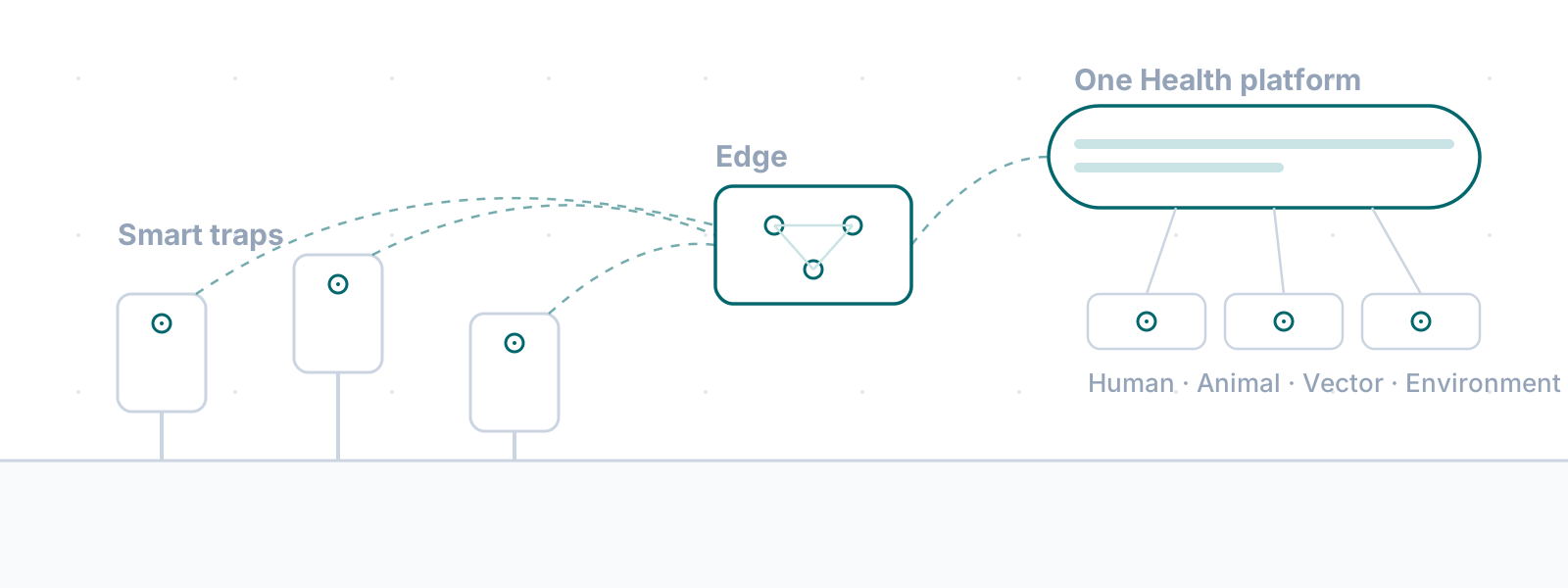
Schematic illustration: smart mosquito traps reporting to an edge hub and on to a shared One Health platform

Background

Mosquito-borne viruses are moving north. West Nile virus has settled at a higher baseline in Europe, with the 2025 season already past the whole of 2023 by early October, and locally acquired dengue, chikungunya and Zika cases now appear in southern Europe most summers. Warmer summers and a growing habitat for the Asian tiger mosquito drive the shift.

Surveillance has not kept up. It is fragmented and reactive, built on slow, centralised diagnostics and data streams that are not connected: human cases in one system, animal cases in another, mosquito counts in a third.

SHIELD (Smart Holistic Integrated Early-warning Laboratory and Digital system for Arbovirus Surveillance) is a three-year EU4Health project, coordinated by the University of Bari Aldo Moro, that replaces this with a dual-use, modular platform: field-deployable molecular diagnostics on one side, digital surveillance powered by AI on the other, under a One Health framework that treats human, animal, vector and environmental data as one picture.
What SHIELD builds

The diagnostic side takes portable molecular diagnostics and lab-on-chip technology from TRL 4 to TRL 7 within 36 months, with the goal of detecting a virus in the field in under 45 minutes rather than days at a central laboratory.

The digital side brings mosquito surveillance, diagnostic results, environmental data and epidemiological models into one interoperable platform, with AI-based analysis of samples and of mosquito populations, risk prediction, and interfaces to European early-warning systems. The whole system is validated across five Member States.

Sensative’s part: the smart traps and their data

Sensative works in the IoT infrastructure work package together with the University of Seville, WINGS ICT Solutions and BEIA Research. The smart mosquito traps deployed across Europe are fitted with multisensory IoT modules developed with Sensative, capturing entomological, environmental and geolocation data. The data travels over LoRaWAN or NB-IoT to local edge hubs and on to the central One Health platform.

Sensative also keeps that flow live: trap data reaches the decision-support backend in real time, so the models update continuously and the maps show what the traps see now. It is the same job Yggio does for cities and buildings, with many sensors, several networks, one data model and one open API, applied to public health.

Consortium

Sixteen partners from nine countries, coordinated by the University of Bari Aldo Moro: research institutes and veterinary institutes in Italy, Spain, Austria and Belgium, diagnostics and ICT companies in Italy, Germany, Greece, Spain, Slovakia, Romania and Sweden. The project kicks off in Bari on 12–13 November 2026.

One HealthPublic healthLoRaWANSmart traps
Other participants (16)
  • University of Bari Aldo Moro (coordinator)
  • Nanophoenix
  • Slovakia Supercomputers
  • Xpedite Diagnostics
  • Fondazione Bruno Kessler
  • WINGS ICT Solutions
  • Ibermática Institute of Innovation
  • Sensative
  • AIT Austrian Institute of Technology
  • Wondergene
  • University of Seville
  • Avia-GIS
  • Istituto Zooprofilattico Sperimentale dell’Abruzzo e del Molise
  • IRTA – Institute of Agrifood Research and Technology
  • BEIA Research
  • Istituto Zooprofilattico Sperimentale delle Venezie
Funded by

Research enquiries

cto@sensative.com